← Back to home

Blog

Short but useful notes from day to day

Call me Pablo

NeurAlch

If you add to your AGENTS.md or CLAUDE.md file the instructions to call you by a certain name, like:

Call me Pablo.

You’ll easily notice when the agent memory/context is degraded, as it will stop calling you by that name.

Wallpaper-driven theme switcher

NeurAlch

Wallpaper-driven theme switcher

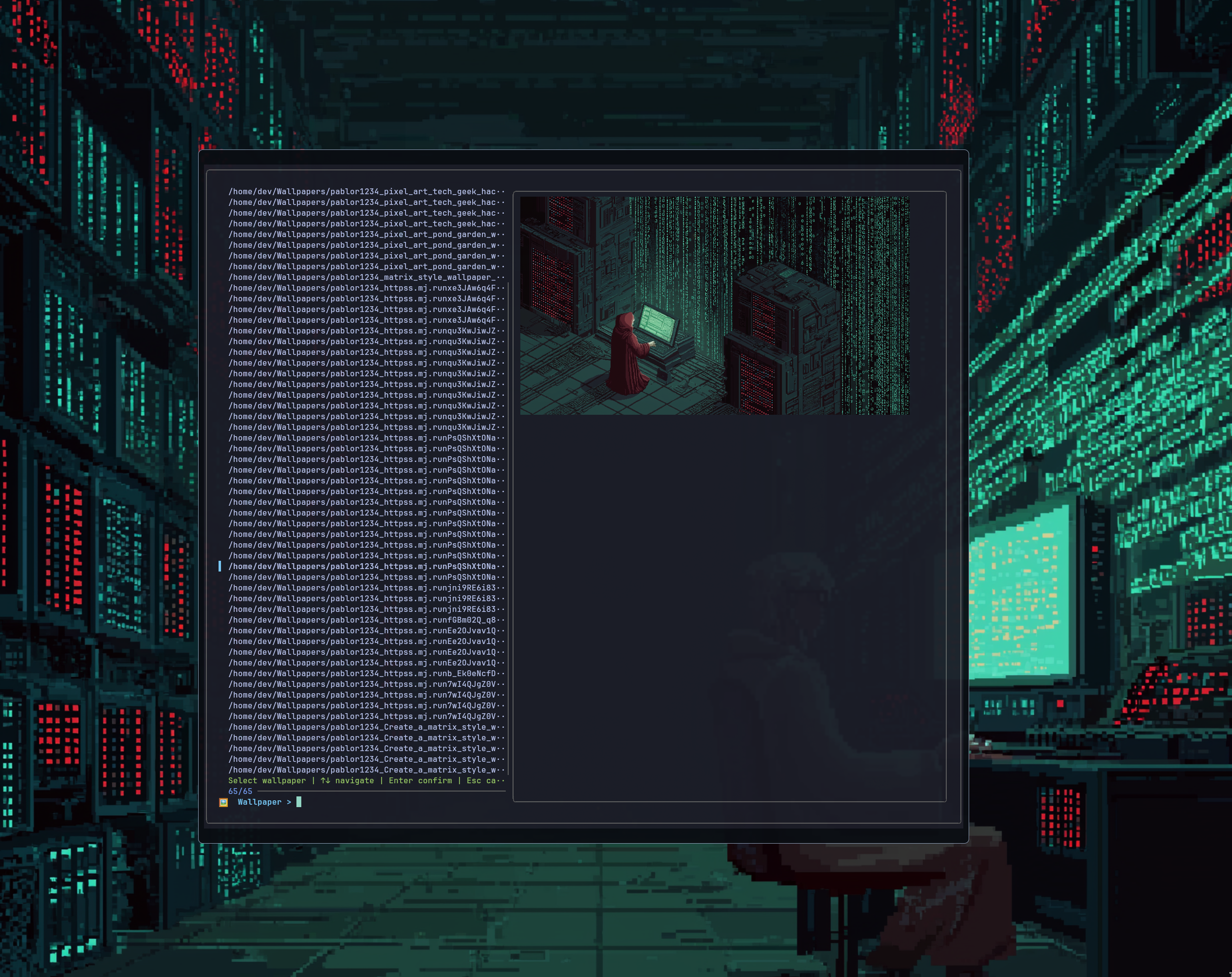
I created a small Fish alias ,tw ( theme-switch --wallpaper). It launches an fzf picker inside Kitty, previews every image in ~/Wallpapers, and lets me lock in the mood based on the image I choose.

Behind the scenes the script hands the chosen file to pywal, grabs the generated 16-color palette, and feeds it to a helper that rewrites all my theme snippets (Hyprland, Waybar, Kitty, Walker, btop, mako, swayosd, etc.).

The fresh palette is saved as a new theme directory, the wallpaper is set via hyprpaper, and the regular theme-switch routine copies everything into place before reloading.

,tw  # pick wallpaper → extract palette → theme everything → reload

fzf wallpaper picker with matching desktop theme

Notes

  • I generate my Wallpaper images with MidJourney
  • I started using Kitty because of the image support (and ligatures).
  • The inspiration came from Aether (for Omarchy) tool.

Understanding code faster with color

NeurAlch

Understanding code faster with color

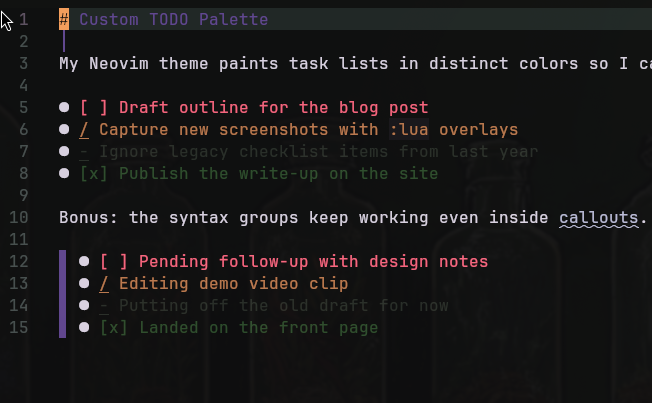
It all started when I had like 100 ToDo items on my ToDo.md file.

I wanted my eyes to ignore the ones that are already completed, and see more prominently the ones left.

So I did something like this, mutted the ones done already to the point that I can barely see them, and made more obvious the ones left to do.

Markdown

Markdown buffer highlighting

Neovim checkbox highlights

Here is the tiny snippet living in my after/ftplugin/markdown.lua to give todo lists their color pop:

-- Drop this in after/ftplugin/markdown.lua
vim.api.nvim_set_hl(0, "TodoUnchecked", { fg = "#ff6984" })
vim.api.nvim_set_hl(0, "TodoChecked", { fg = "#30502f", strikethrough = true })
vim.fn.matchadd("TodoUnchecked", "^.*\\[ \\].*$")
vim.fn.matchadd("TodoChecked", "^.*\\[x\\].*$")

TSX/TS

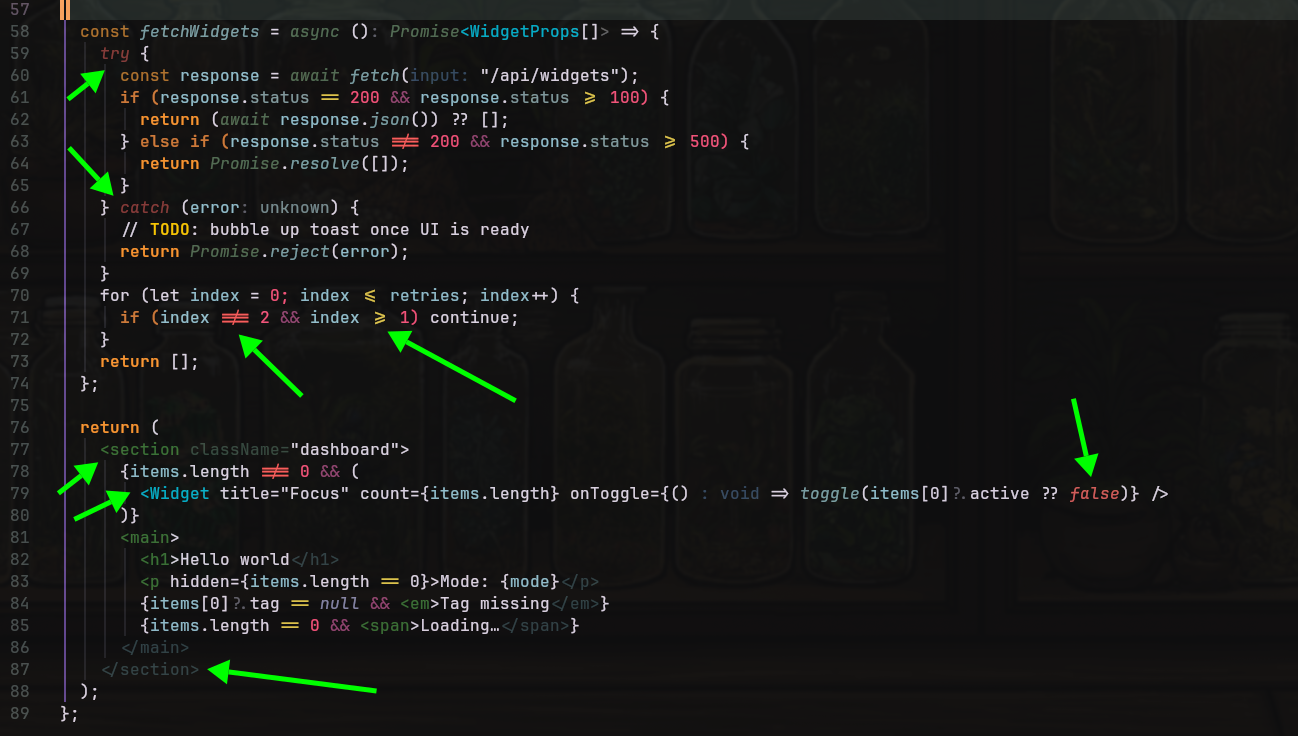
Then I realized the same technique can be used for things like try/catch, where I want to make it obvious that this is important (red).

Then there is making it easier to read HTML/JSX, a bunch of nested JSX/HTML tags? Why not mute the closing ones like </Tag>? This makes it pretty easy to read, feels a bit like Python indentation (maybe?).

A hundred className=? Let us also mute that noise…

Is a condition positive or negative? Like != is not the same as ==, so why not use different colors? Same for boolean true/false.

TSX buffer highlighting

Python

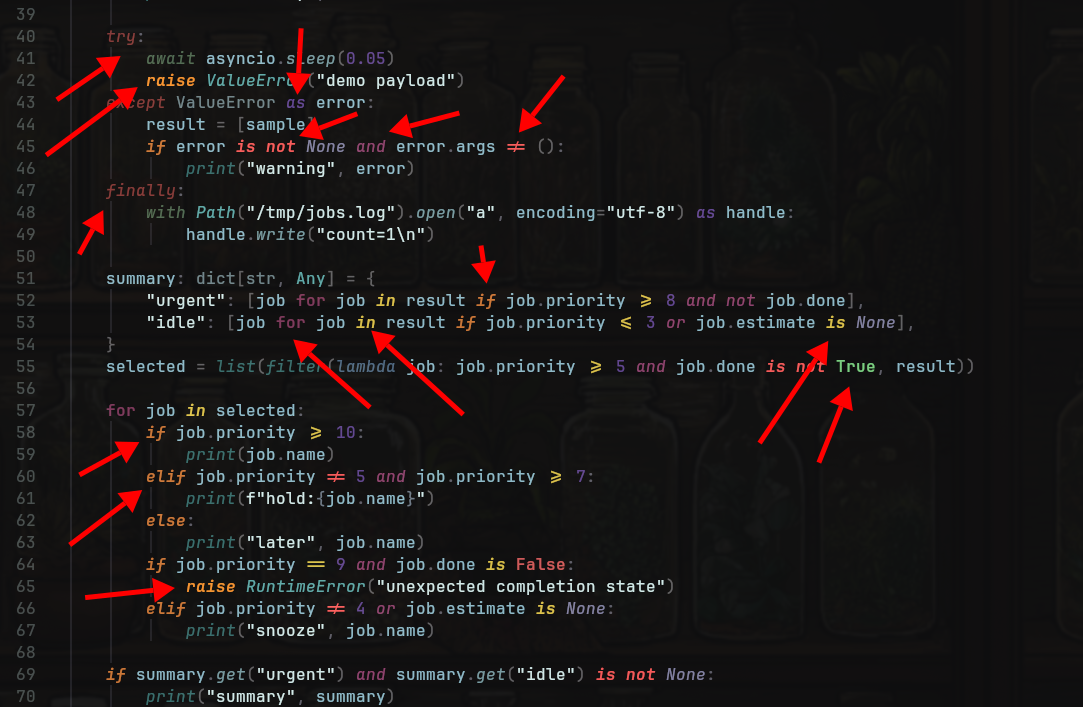
I tried a few things with Python as well, still a work in progress.

Python buffer highlighting

Conclusion

This experiment turned out a success, I managed to speed up my reading/understanding time.

Still improving but so far, I love it.